



Many lenders pre-empted the decision which caused fixed mortgage rates to soar in recent months.
The Bank of England has raised the base rate from 3.75% to 4% as it looks to get inflation under control.
This is the first time in more than three years that its Monetary Policy Committee (MPC) has voted in favour of increasing the UK’s central interest rate, however, the move was highly anticipated by economists as many households and businesses have been feeling the pinch of higher costs.
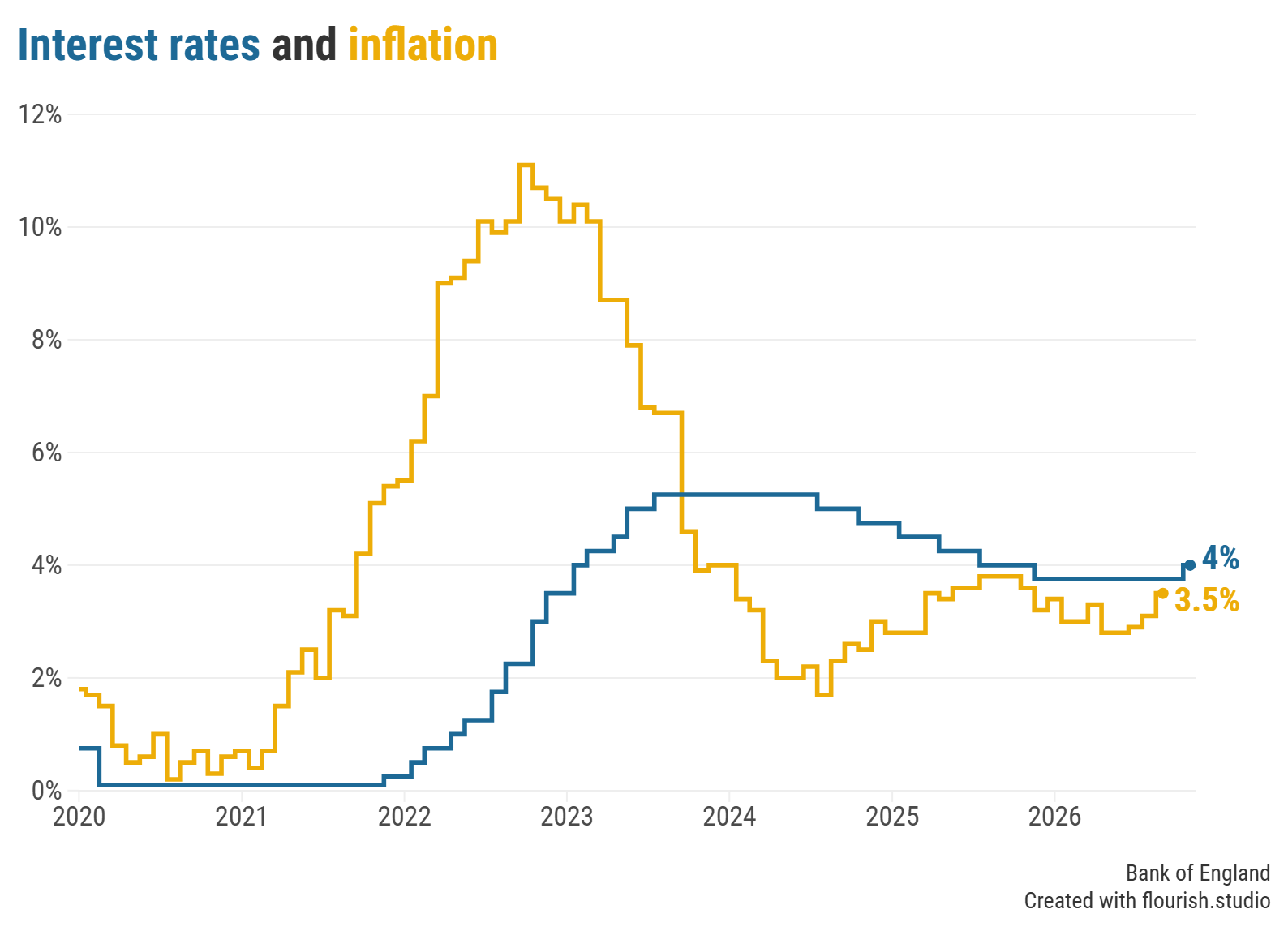
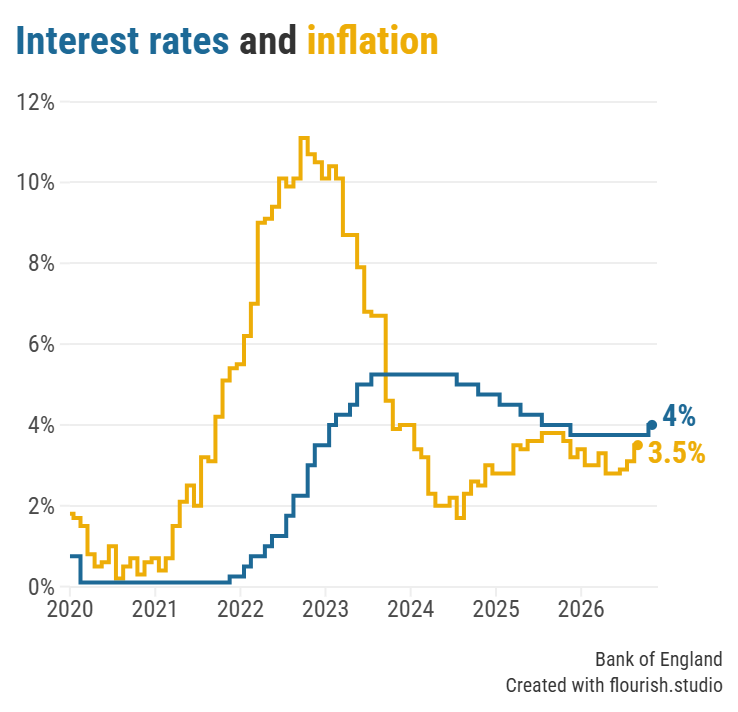
Latest UK Finance Trends: Bank of England Base Rate vs the rate of inflation between 2020 and 2026.
While it had seemed that inflation was on course to ease closer towards the Bank’s 2% target at the very start of this year, the trajectory quickly shifted following the outbreak of the Iran war in February. Only last month, the Office for National Statistics revealed that the rate at which costs of goods and services are rising had accelerated to 3.5% in the 12 months to September – its highest level so far this year.
The base rate is the amount of interest the Bank of England charges other banks, building societies and financial institutions to borrow money which, in turn, influences how these organisations price their mortgages and savings products.
This means that the Bank of England can use the base rate as a tool to keep inflation in check. During periods of high inflation, for example, the Bank might increase the base rate to lower demand (by making it more expensive to borrow money and more rewarding to save). Conversely, lowering the base rate can help to stimulate economic growth (by making borrowing cheaper to encourage greater levels of spending).
Learn more about inflation and the Bank of England base rate.
Turbulence in the swap market, as well as ongoing cost of living pressures, meant many lenders pre-empted the decision to raise the base rate when setting their fixed mortgage prices over recent months. As a result, the average rate charged by a two-year fixed deal soared from 5.59% at the start of September to 5.97% at the beginning of this month, while the average five-year fixed mortgage rate jumped from 5.63% to 6.00% over the same period. These increases contributed to the Moneyfacts Average New Mortgage Rate reaching a three-year high of 5.89% by the start of November.
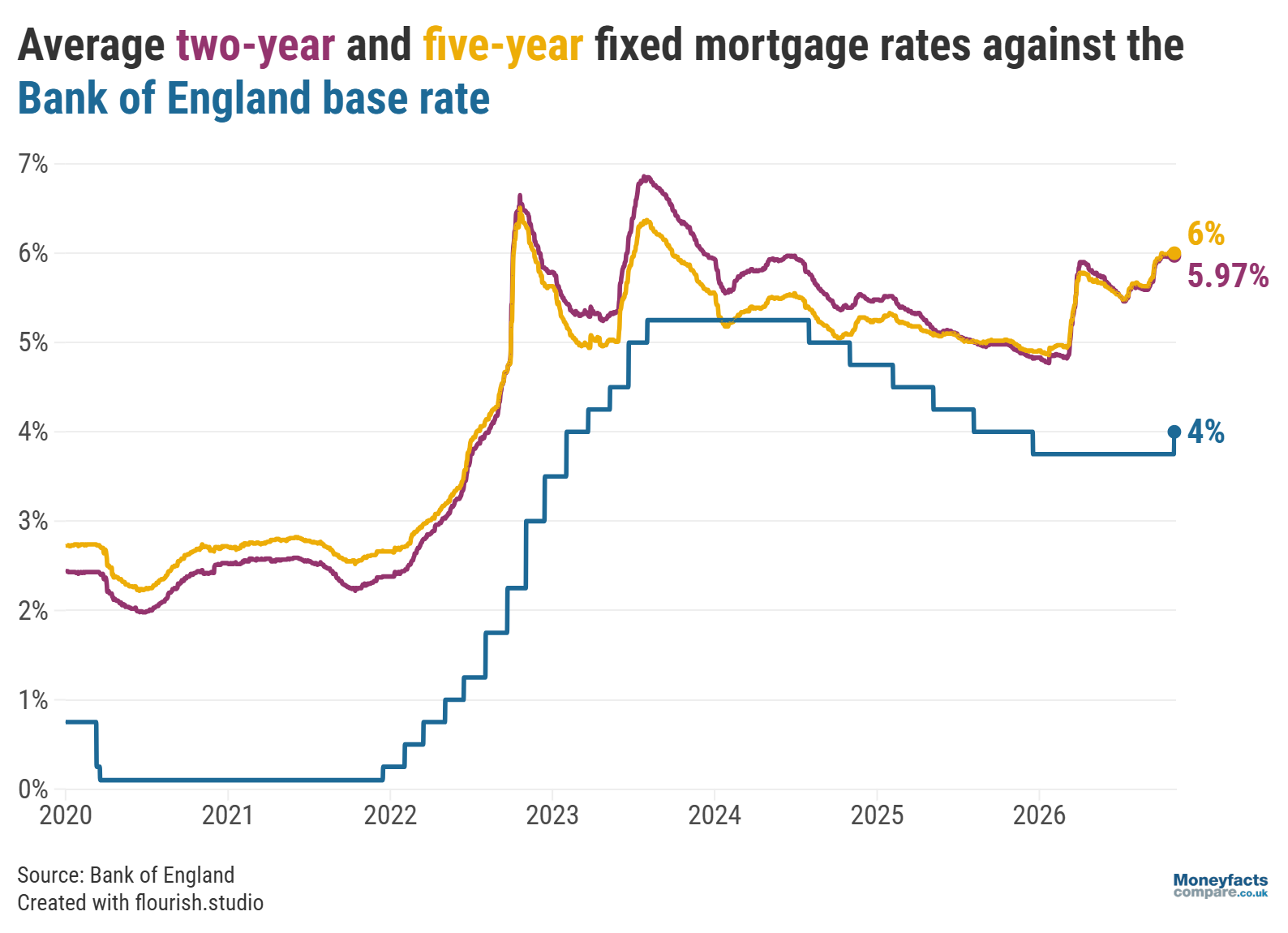
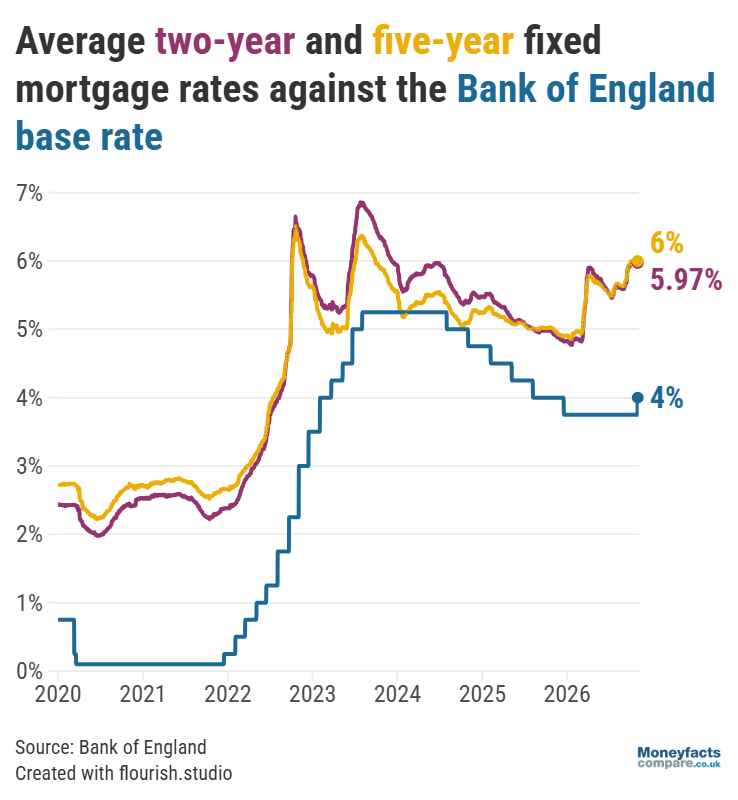
Latest UK Mortgage Trends: Bank of England Base Rate vs average two- and five-year fixed mortgage rates between 2020 and 2026.
Notably, some of the lowest two-year fixed rates from high street lenders, including Barclays, HSBC, Lloyds Bank, NatWest and Santander remained around 0.44 percentage points higher on average at the start of this week than the beginning of September.
“Lenders could well pivot away from making aggressive rises over the coming weeks,” said Rachel Springall, Finance Expert at Moneyfactscompare.co.uk, adding that some might even make small cuts before the year is over if they have overcompensated for swap market volatility.
However, it could be some time before conditions improve significantly. “Lenders look at their margins very carefully, so it would be unwise to price deals too low when uncertainty remains,” said Springall. With conflicts in the Middle East and between Russia and Ukraine “on a knife-edge”, she also warned that “prolonged pressure on global inflation” could just as easily “worsen the outlook for UK interest rates”.
Our mortgage charts are regularly updated throughout the day so you can easily monitor the lowest rates currently available.
But, bear in mind that the deal charging the cheapest rate may not be the most suitable or cost-effective for your circumstances, which is why it’s crucial to consider all features of a mortgage carefully (such as the lending area, any fees and incentives).
For this reason, our weekly mortgage roundup not only provides a summary of the lowest fixed mortgage rates, but also offers some alternative options that earn spots on our Moneyfacts Best Buy chart based on their overall true cost.

Approximately 2.3 million fixed mortgages are set to expire by the end of 2027, according to UK Finance. For those coming off a guaranteed rate, it might prove more cost-effective to secure a new deal sooner rather than later.
“Delaying plans to get a mortgage this year has already come to haunt borrowers,” Springall cautioned, as the average two-year fixed rate has risen by more than a whole percentage point since January – adding almost £170 to monthly repayments (or over £2,000 per year)*.
What’s more, those who risk falling onto a lender’s Standard Variable Rate (SVR) while waiting for costs to come down could find themselves a further £182 worse off per month than if they locked into a typical two-year fixed deal**.
Borrowers who’d prefer a bit more flexibility could explore variable rate tracker mortgages – many of which don’t impose any Early Repayment Charges (although it’s important to check a deal’s specific terms and conditions carefully). The average rate charged by a two-year tracker stood at 4.68% at the beginning of November, more than one percentage point below its fixed counterpart, which may add to the appeal.
Tracker mortgages are a type of variable rate mortgage where the amount of interest charged will rise and fall in line with changes to the Bank of England base rate (usually at a set amount above it).
“The big disparity between fixed and tracker mortgage rates means that a tracker deal could be a more affordable option for some borrowers – even when factoring in today’s base rate hike,” said Oliver Dack, Spokesperson at Mortgage Advice Bureau (MAB). “Indeed, we’re having an increased number of conversations with our clients about tracker deals – possibly more now than in recent years,” he continued.
However, it’s crucial borrowers consider whether they could comfortably meet their mortgage repayments if rates were to rise further. Economists currently expect the Bank of England to increase the base rate by another 0.25 percentage points by February (but forecasts can quickly change).
“Ultimately, the best option will depend on a borrower’s unique circumstances, which is why it can be useful to get tailored advice from a mortgage broker,” said Dack.
MAB is the preferred mortgage broker of Moneyfactscompare.co.uk

Get friendly, expert advice free of charge as a visitor of Moneyfactscompare.co.uk
Mortgage Advice Bureau have 1,600 UK advisers with 200 awards between them.
Speak to an award-winning mortgage broker today.
Call 0800 031 8553 or request a callback
Mortgage Advice Bureau offers fee free mortgage advice for Moneyfactscompare.co.uk visitors that call on 0800 031 8553. If you contact Mortgage Advice Bureau outside of these channels you may incur a fee of up to 1%. Lines are open Monday to Friday 8am to 8pm and Saturday 9am to 1pm excluding bank holidays. Calls may be recorded.
Your home may be repossessed if you do not keep up repayments on your mortgage.
Although raising the base rate can benefit savers, they shouldn’t assume that the increase will automatically be passed on to their existing variable rate accounts.
“Savers have endured years of unrewarded loyalty, with those leaving cash in closed accounts losing out on an extra £139† over the past three years compared to on sale easy access accounts,” said Springall. “Only if savers have a flexible pot that’s tethered to the Bank of England Base Rate [are they guaranteed to] see an uplift, for others, it could be time to switch and ditch their old account,” she continued.
Those shopping the market for a new account may find some of the highest rates offered by challenger banks and mutuals. A selection of the most flexible easy access accounts from big UK banks pay just 1.16% on average‡; by contrast, a typical easy access account offered 2.56% at the start of this month and the most competitive options currently pay more than 4%.
Meanwhile, savers with a lump sum who are comfortable locking away their cash could earn an even better return with a fixed bond as many of the market-leading accounts offer over 5%.

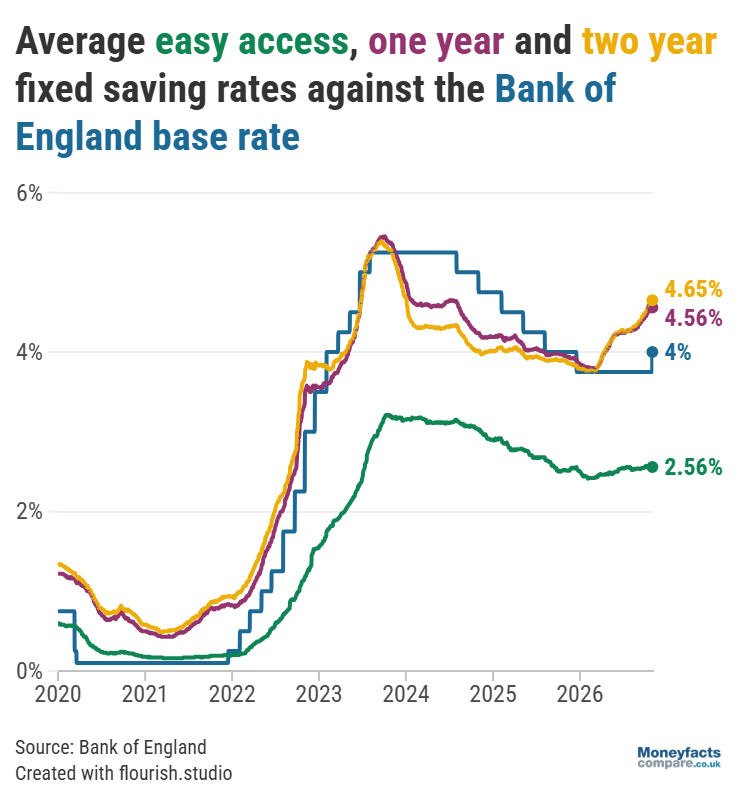
Latest UK Savings Trends: Bank of England Base Rate vs average easy access, one- and two-year fixed savings rates between 2020 and 2026.
But, when it comes to earning a higher interest rate, it’s crucial savers consider the possible impact on their tax liability. “Due to fiscal drag, many more savers are facing a tax bill on their savings income,” warned Springall, adding that these tax rates are set to rise by four percentage points from April 2027.
“This makes the appeal of Cash ISAs ever more enticing, so it is no wonder that a staggering £45 billion has been deposited so far this year. Now that the Government has made a U-turn to keep the full £20,000 Cash ISA allowance, it will be a great time for savers to ensure they are making the most of it to protect their hard-earned cash from tax,” she continued.
Our savings charts are regularly updated throughout the day so you can easily find and compare the best rates currently available.
Also read our weekly savings and ISA roundups for more information on some of the most competitive accounts, and subscribe for free to our Savers Friend newsletter for updates on the latest changes from across the savings market.
* Based on a £250,000 mortgage over 25 years.
** Based on a £250,000 mortgage over 25 years at the average Standard Variable Rate of 7.13% vs the average two-year fixed mortgage rate of 5.97% (as of 1 November 2026).
† Based on a £20,000 balance.
‡ Big bank easy access selection: Barclays Bank, Everyday Saver, 1.00%. HSBC, Flexible Saver, 1.04%. Lloyds Bank, Easy Saver, 0.75%. NatWest, Flexible Saver, 1.00%. Santander Easy Access Saver, 2.00%.

All of our newsletters are available free by email to all Moneyfactscompare.co.uk users.
Send me Weekend Moneyfactscompare, Savers Friend, and Companies Friend.
Information is correct as of the date of publication (shown at the top of this article). Any products featured may be withdrawn by their provider or changed at any time. Links to third parties on this page are paid for by the third party. You can find out more about the individual products by visiting their site. Moneyfactscompare.co.uk will receive a small payment if you use their services after you click through to their site. All information is subject to change without notice. Please check all terms before making any decisions. This information is intended solely to provide guidance and is not financial advice. Moneyfacts will not be liable for any loss arising from your use or reliance on this information. If you are in any doubt, Moneyfacts recommends you obtain independent financial advice.


Moneyfactscompare.co.uk will never contact you by phone to sell you any financial product. Any calls like this are not from Moneyfacts. Emails sent by Moneyfactscompare.co.uk will always be from news@moneyfacts-news.co.uk. Be ScamSmart.
Moneyfactscompare.co.uk will never contact you by phone to sell you any financial product. Any calls like this are not from Moneyfacts. Emails sent by Moneyfactscompare.co.uk will always be from news@moneyfacts-news.co.uk. Be ScamSmart.
Moneyfactscompare.co.uk will never contact you by phone to sell you any financial product. Any calls like this are not from Moneyfacts. Emails sent by Moneyfactscompare.co.uk will always be from news@moneyfacts-news.co.uk. Be ScamSmart.

Moneyfactscompare.co.uk will never contact you by phone to sell you any financial product. Any calls like this are not from Moneyfacts. Emails sent by Moneyfactscompare.co.uk will always be from news@moneyfacts-news.co.uk. Be ScamSmart.
Moneyfactscompare.co.uk will never contact you by phone to sell you any financial product. Any calls like this are not from Moneyfacts. Emails sent by Moneyfactscompare.co.uk will always be from news@moneyfacts-news.co.uk. Be ScamSmart.
Moneyfactscompare.co.uk will never contact you by phone to sell you any financial product. Any calls like this are not from Moneyfacts. Emails sent by Moneyfactscompare.co.uk will always be from news@moneyfacts-news.co.uk. Be ScamSmart.

