



Leading one- to five-year fixed savings rates pay above 5.00% for the first time since December 2023.
Savings rates have continued their upwards trajectory, with the average one-year fixed savings rate rising for the seventh consecutive month to reach 4.41% at the start of October, its highest level since September 2024. Meanwhile, the average longer-term fixed rate increased for an eighth consecutive month in October to 4.49%, its highest since December 2023, the latest Moneyfacts UK Savings Trends Treasury Report revealed.
“While volatile swap rates have been causing mayhem for borrowers, savings rates are telling a more positive story,” Caitlyn Eastell, Personal Finance Analyst at Moneyfactscompare.co.uk, commented.
“Average non-ISA fixed rates have been rising consistently for over six months, and this is the longest sustained period of increases since 2023 for one-year fixed and 2022 for longer-term deals,” she continued.
Alongside these rises in average rates, the top rates have also seen attractive increases across the board, with one- to five-year bonds paying over 5.00% at the start of October for the first time since December 2023. This means savers have plenty of opportunities to maximise their returns, which could be particularly promising for those whose savings are currently languishing in a low-paying account, or with a fixed bond about to mature, Eastell explained.
A saver with £10,000 could take home around £215 more in interest if they deposited their money into the top one-year fixed bond paying 5.15% AER than if they placed it in an account paying 3%, stressing the importance of shopping the market for a competitive return.
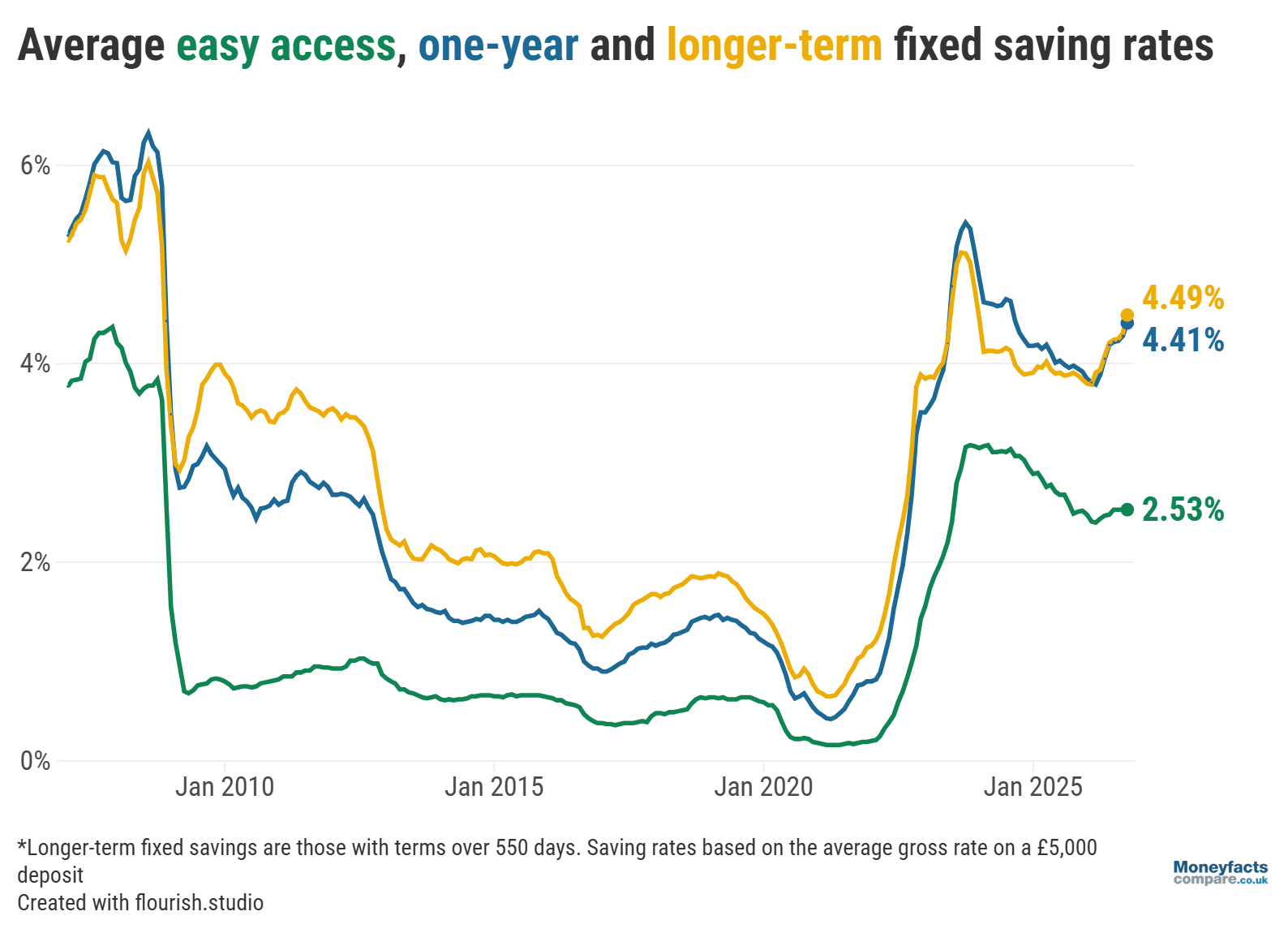
Graph: Average easy access, one-year and longer-term fixed savings rates between 2008 and 2026.
Those wanting to secure a tax-free return on their savings will find they have more choice than ever as the number of cash ISA products on the market hit a record high of 762 at the start of October. Following elevated competition, all average ISA rates climbed higher between September and October, including variable ISA rates which have risen for the first time since May.
Meanwhile, the average one-year fixed ISA rate reached 4.39%, and the average return on a longer-term ISA rose to 4.44%, their highest since August 2024 and December 2023, respectively.
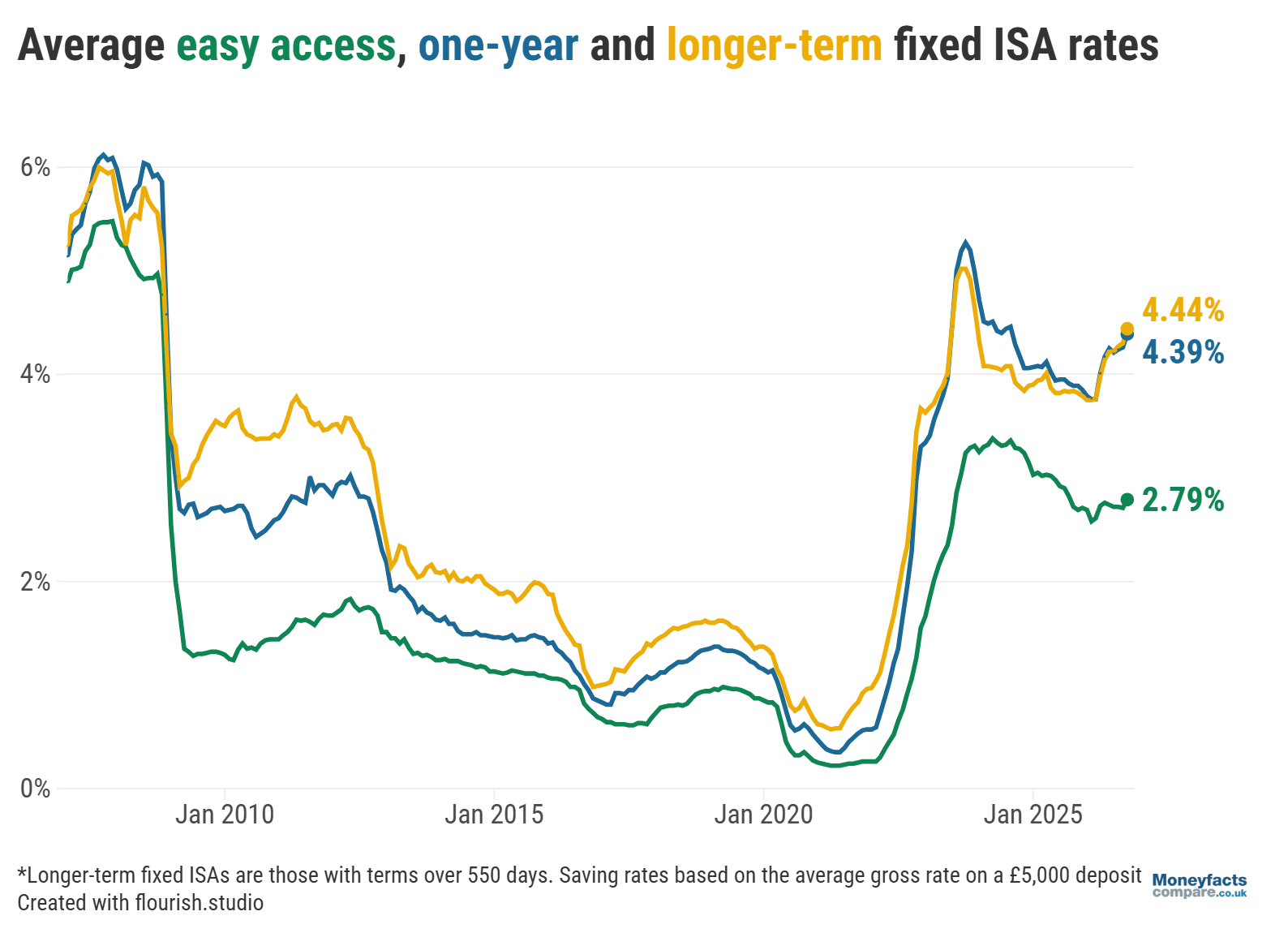
Graph: Average easy access, one-year and longer-term fixed ISA rates between 2008 and 2026.
“Typically, ISAs pay out slightly lower returns compared to their [savings] counterparts,” Eastell pointed out, “however, some of the most attractive fixed ISAs now also pay over 5%, meaning savers don’t have to compromise on their tax-free savings”. Currently, the highest return available on a fixed rate ISA is 5.25% AER (as of 14 October).
And, as the deadline for cash ISA changes in April looms, there could be further competition. From April 2027, the amount savers aged under 65 can put into cash ISAs is set to be cut from £20,000 to £12,000. However, those over 65 will still be able to deposit £20,000 into cash ISAs per tax-year. Eastell said, considering this, “providers may work even harder to attract savers’ deposits”.
See our savings and ISA charts for the top returns and, for a weekly overview, visit our ISA and savings roundups. For the latest changes in the savings market delivered straight to your inbox, subscribe to our Savers Friend newsletter for free today.

All of our newsletters are available free by email to all Moneyfactscompare.co.uk users.
Send me Weekend Moneyfactscompare, Savers Friend, and Companies Friend.
Information is correct as of the date of publication (shown at the top of this article). Any products featured may be withdrawn by their provider or changed at any time. Links to third parties on this page are paid for by the third party. You can find out more about the individual products by visiting their site. Moneyfactscompare.co.uk will receive a small payment if you use their services after you click through to their site. All information is subject to change without notice. Please check all terms before making any decisions. This information is intended solely to provide guidance and is not financial advice. Moneyfacts will not be liable for any loss arising from your use or reliance on this information. If you are in any doubt, Moneyfacts recommends you obtain independent financial advice.


Moneyfactscompare.co.uk will never contact you by phone to sell you any financial product. Any calls like this are not from Moneyfacts. Emails sent by Moneyfactscompare.co.uk will always be from news@moneyfacts-news.co.uk. Be ScamSmart.
Moneyfactscompare.co.uk will never contact you by phone to sell you any financial product. Any calls like this are not from Moneyfacts. Emails sent by Moneyfactscompare.co.uk will always be from news@moneyfacts-news.co.uk. Be ScamSmart.
Moneyfactscompare.co.uk will never contact you by phone to sell you any financial product. Any calls like this are not from Moneyfacts. Emails sent by Moneyfactscompare.co.uk will always be from news@moneyfacts-news.co.uk. Be ScamSmart.
Moneyfactscompare.co.uk will never contact you by phone to sell you any financial product. Any calls like this are not from Moneyfacts. Emails sent by Moneyfactscompare.co.uk will always be from news@moneyfacts-news.co.uk. Be ScamSmart.
Moneyfactscompare.co.uk will never contact you by phone to sell you any financial product. Any calls like this are not from Moneyfacts. Emails sent by Moneyfactscompare.co.uk will always be from news@moneyfacts-news.co.uk. Be ScamSmart.
Moneyfactscompare.co.uk will never contact you by phone to sell you any financial product. Any calls like this are not from Moneyfacts. Emails sent by Moneyfactscompare.co.uk will always be from news@moneyfacts-news.co.uk. Be ScamSmart.
