



However, mortgage borrowers and savers shouldn’t be complacent.
No change to the base rate was announced today as the Bank of England’s Monetary Policy Committee (MPC) keeps a watchful eye on latest developments – both at home and overseas.
Since it last voted to hold the UK’s central interest rate at 3.75% in June, Andy Burnham has replaced Sir Keir Starmer as Prime Minister (and subsequently appointed John Healey as Chancellor of the Exchequer). As is the case with any new Government, their approach to tax, state borrowing and public spending has the potential to alter economic forecasts.
Meanwhile, the recent re-escalation of conflict in the Middle East places renewed pressure on global oil supplies and is once again threatening to drive up the cost of living. Although figures released last week from the Office for National Statistics (ONS) revealed UK inflation dipped to 2.6% in the 12 months to June, there are expectations for it to reaccelerate in the coming months which could prompt the MPC to raise the base rate later this year.
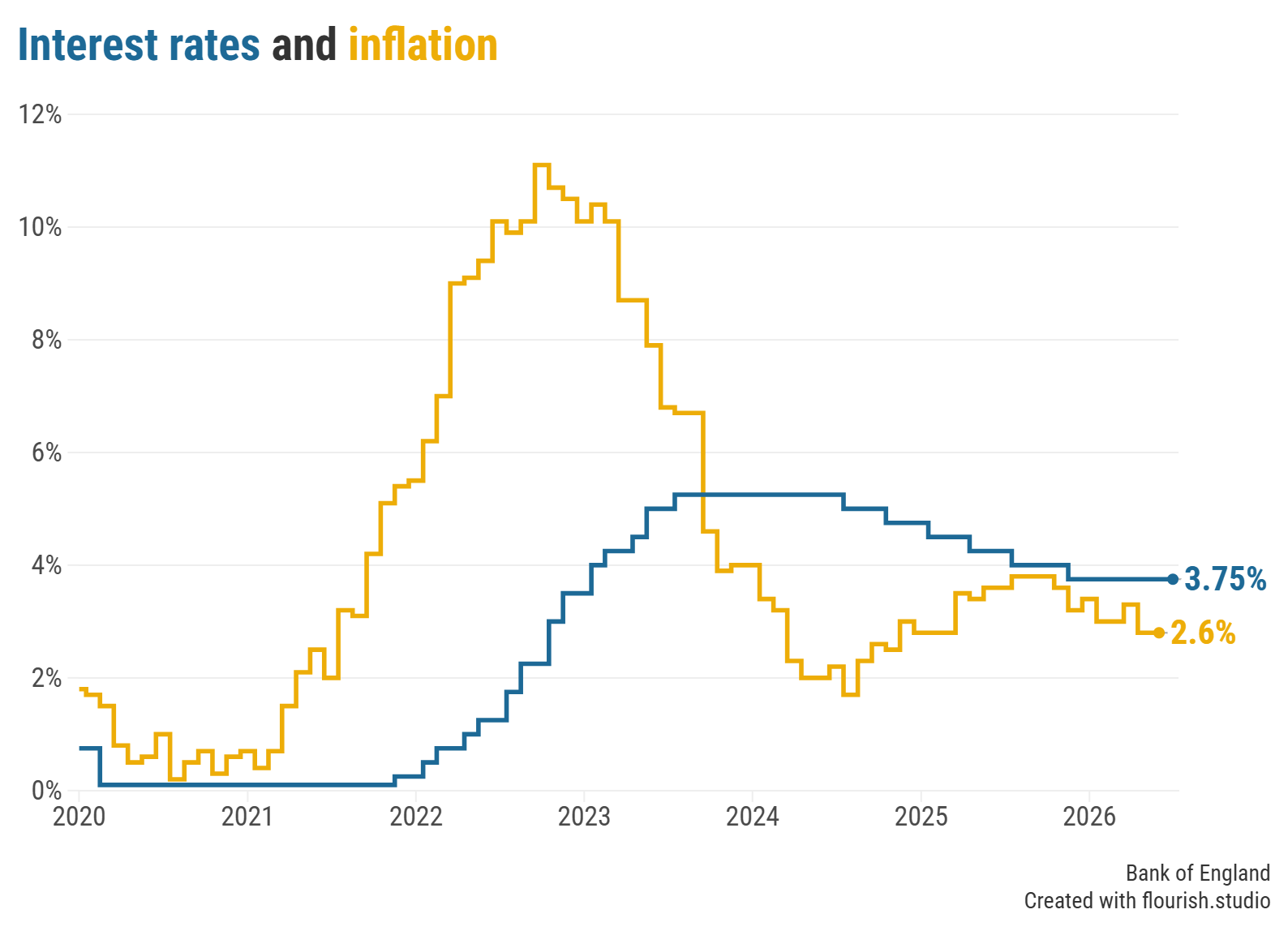
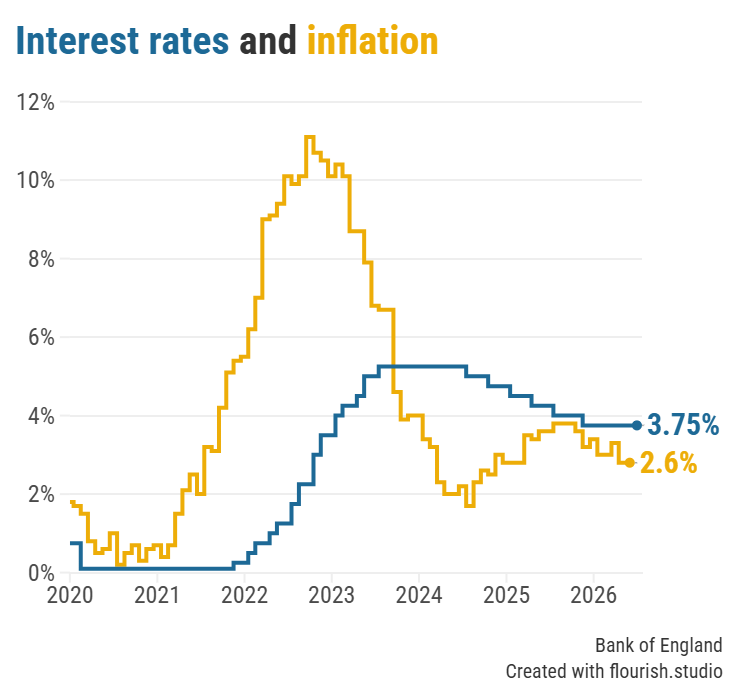
UK Finance Trends: Bank of England base rate vs inflation between 2020 and 2026.
The base rate is the amount of interest the Bank of England charges commercial banks, building societies and other financial institutions to borrow money which, in turn, influences how these organisations price their mortgages and savings products.
It can be used as a tool to keep inflation in check. During periods of high inflation, for instance, the Bank of England might raise the base rate to reduce demand (by making it more expensive to borrow money and rewarding those who save). In contrast, the Bank of England could lower the base rate to stimulate economic growth (by making borrowing cheaper to encourage greater levels of spending).
Learn more about inflation and the Bank of England base rate.
However, lenders don’t always wait for the Bank of England to act before reassessing their mortgage rates; in fact, they’ll often prioritise swap rates when setting their fixed pricing. Unfortunately for borrowers, recent volatility in the swap market has seen the average two- and five-year fixed mortgage rates jump from 5.52% at the beginning of the month to 5.62% and 5.66% respectively yesterday – despite the base rate going unchanged.
Nevertheless, Rachel Springall, Finance Expert at Moneyfactscompare.co.uk, said “it is still worth moving off an expensive revert rate to a fixed deal”, adding that someone opting for a typical five-year fixed mortgage could save around £2,800 a year*.
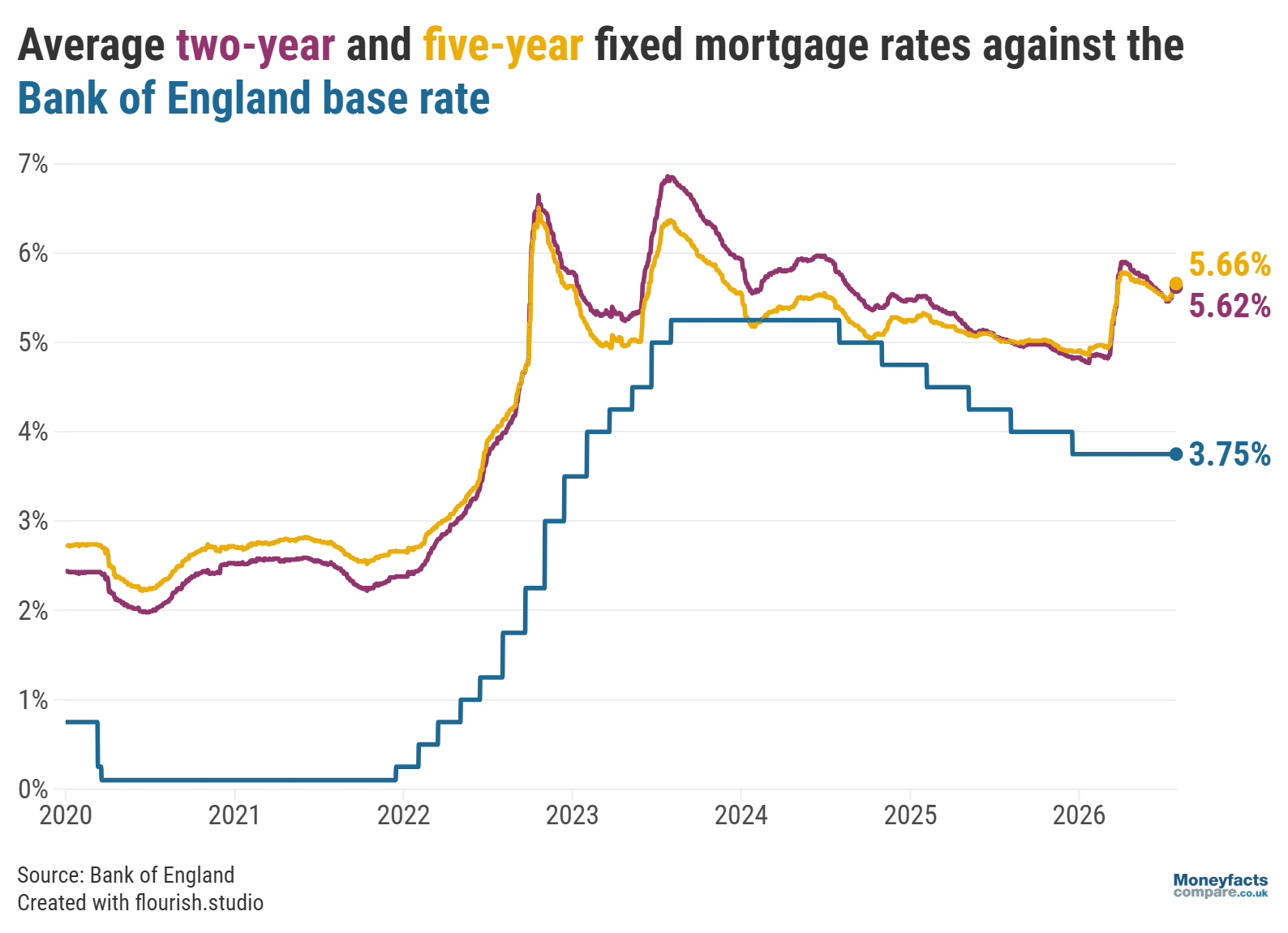
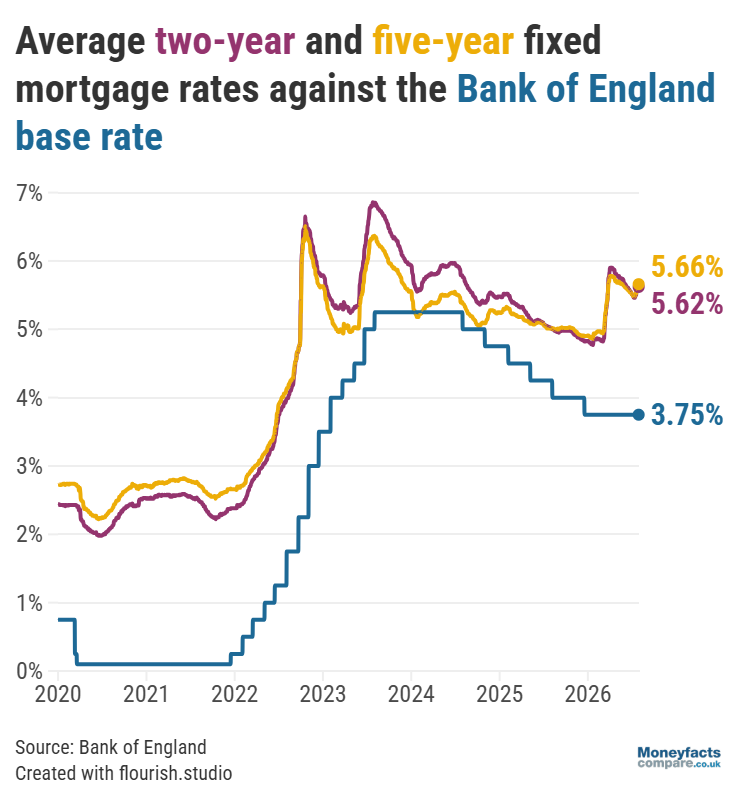
UK Mortgage Trends: Average two- and five-year fixed mortgage rates between 2020 and 2026.
Some borrowers might also feel tempted to explore a tracker mortgage – with the average two-year tracker deal charging a more palatable 4.51% as of yesterday. But, “while tracker mortgages may seem cheap right now, borrowers must be aware that their repayments could rise sharply as lenders will be quick to pass on any potential base rate hikes to their variable deals”, Oliver Dack, Spokesperson at Mortgage Advice Bureau, cautioned.
“We understand that some borrowers will value flexibility amid the ongoing uncertainty, however, our clients can rest assured that we regularly monitor the market and will look to move them onto a cheaper deal should one become available before their start date,” Dack added.
By contrast, Springall warned borrowers who don’t take action that their indecisiveness could prove costly. “An interest rate rise of 0.25% would increase repayments by around £450 a year, and a 0.50% rise would result in a rise of around £900,” she explained†.
This might be particularly concerning for those looking to join the property ladder with a small deposit, as the average five-year fixed rate at 95% loan-to-value (LTV) already sits above 6%.
“First-time buyers who can save a 10% deposit will not only have more purchasing power, but they will also widen the choice of cheaper mortgage rates,” said Springall. “Those who borrow £250,000 over 25 years will pay £600 less on their mortgage per year, compared to the average rate available to borrowers with a 5% deposit on a five-year fixed deal,” she continued.
While reaching a deposit of this size could prove difficult due to a lack of affordable housing, Springall said there has been lots of innovation from lenders to support homeownership. This includes mortgages that can finance up to 98% LTV from the likes of Leeds BS and Santander, and other options that require a small deposit of just £5,000 from Yorkshire Building Society and Lloyds Bank.
However, she said “seeking advice from a broker is essential to navigate the mortgage maze and understanding lender criteria, particularly how much someone can borrow based on their salary and the fact that higher loan-to-value options can exclude new build properties”.
“Borrowers who apply direct for a loan could face disappointment without good guidance,” Springall added.
MAB is the preferred mortgage broker of Moneyfactscompare.co.uk

Get friendly, expert advice free of charge as a visitor of Moneyfactscompare.co.uk
Mortgage Advice Bureau have 1,600 UK advisers with 200 awards between them.
Speak to an award-winning mortgage broker today.
Call 0800 031 8553 or request a callback
Mortgage Advice Bureau offers fee free mortgage advice for Moneyfactscompare.co.uk visitors that call on 0800 031 8553. If you contact Mortgage Advice Bureau outside of these channels you may incur a fee of up to 1%. Lines are open Monday to Friday 8am to 8pm and Saturday 9am to 1pm excluding bank holidays. Calls may be recorded.
Your home may be repossessed if you do not keep up repayments on your mortgage.
Savers are also being urged to shop around, with some of the best fixed returns reaching levels not seen in well over a year.
“Whether savers choose a shorter-term bond for one year, or a longer-term commitment of a five-year deal, both top rates have risen substantially in recent months,” said Springall. “This rare dose of good news for savers is somewhat of a silver lining after years of poor real returns,” she continued.
But, savers may need to move quickly to get their hands on a competitive deal. While Springall said “it would be unwise to rule out any changes to the [base rate] this year”, she stressed that fixed savings rates aren’t tethered to fluctuations in the UK’s central interest rate. “If a challenger bank reaches its funding targets, this in turn can lead to a rate cut or the deal being pulled entirely,” she explained.
Similarly, savers who prefer the convenience of an easy access account mustn’t be complacent; it’s likely many are missing out on higher returns as their loyalty goes unrewarded in a closed account paying just 2.40% on average.
“Over the course of 12 months, savers could miss out on over £400 in interest if they leave their cash to languish in a closed account if they have £20,000 saved,” said Springall‡.
“The message is clear, savers must feel encouraged to take advantage of lucrative returns on offer, regardless of any hold or change to the Bank of England base rate,” she concluded.
Our savings and ISA charts are updated every day between 9am and 5pm so you can easily find and compare the best rates currently available.
Also check our our weekly savings and ISA roundups for more information on some of the most competitive accounts, or subscribe to our Savers Friend newsletter for regular updates from across the savings market.
* Based on a £250,000 mortgage over a 25-year term on a repayment basis, when compared with the average Standard Variable Rate of 7.13%).
† Based on the average five-year fixed rate of 5.66%, on a typical mortgage of £250,000 over 25 years.
‡ Based on a £20,000 investment earning 2.40% over 12 months earning £480 in interest compare to 4.51% gross paid by Tembo Money's HomeSaver (earning £902) - a difference of £422.

All of our newsletters are available free by email to all Moneyfactscompare.co.uk users.
Send me Weekend Moneyfactscompare, Savers Friend, and Companies Friend.
Information is correct as of the date of publication (shown at the top of this article). Any products featured may be withdrawn by their provider or changed at any time. Links to third parties on this page are paid for by the third party. You can find out more about the individual products by visiting their site. Moneyfactscompare.co.uk will receive a small payment if you use their services after you click through to their site. All information is subject to change without notice. Please check all terms before making any decisions. This information is intended solely to provide guidance and is not financial advice. Moneyfacts will not be liable for any loss arising from your use or reliance on this information. If you are in any doubt, Moneyfacts recommends you obtain independent financial advice.


Moneyfactscompare.co.uk will never contact you by phone to sell you any financial product. Any calls like this are not from Moneyfacts. Emails sent by Moneyfactscompare.co.uk will always be from news@moneyfacts-news.co.uk. Be ScamSmart.
Moneyfactscompare.co.uk will never contact you by phone to sell you any financial product. Any calls like this are not from Moneyfacts. Emails sent by Moneyfactscompare.co.uk will always be from news@moneyfacts-news.co.uk. Be ScamSmart.
Moneyfactscompare.co.uk will never contact you by phone to sell you any financial product. Any calls like this are not from Moneyfacts. Emails sent by Moneyfactscompare.co.uk will always be from news@moneyfacts-news.co.uk. Be ScamSmart.
Moneyfactscompare.co.uk will never contact you by phone to sell you any financial product. Any calls like this are not from Moneyfacts. Emails sent by Moneyfactscompare.co.uk will always be from news@moneyfacts-news.co.uk. Be ScamSmart.
Moneyfactscompare.co.uk will never contact you by phone to sell you any financial product. Any calls like this are not from Moneyfacts. Emails sent by Moneyfactscompare.co.uk will always be from news@moneyfacts-news.co.uk. Be ScamSmart.
Moneyfactscompare.co.uk will never contact you by phone to sell you any financial product. Any calls like this are not from Moneyfacts. Emails sent by Moneyfactscompare.co.uk will always be from news@moneyfacts-news.co.uk. Be ScamSmart.

